
Spring Bank Holiday dates
The UK Spring Bank Holiday, often seen as the gateway to summer, is scheduled for the following dates:
- Monday, 25th May 2026
- Monday, 31st May 2027
- Monday, 29th May 2028
The Spring Bank Holiday takes place every year during the end of May, starting on a Friday and lasting until the following Monday as a long weekend.
Origins
The UK Spring Bank Holiday1 dates back to the development of public holidays during the 19th century, a period shaped by industrialisation, social reform, and changing attitudes to work and leisure. Although today it is associated with late May and often seen as the gateway to summer, its origins lie in earlier religious observances and Victorian-era legislation.
Before the 19th century, there was no standardised system of public holidays in Britain. Days off were largely determined by religious festivals, known as ‘holy days,’ such as Easter, Whitsun (Pentecost), and Christmas. Many of these days gradually became secularised, and the term ‘holiday2’ itself evolved from ‘holy day.’ However, observance varied widely by region, occupation, and employer. As industrialisation expanded, factory work and urban life reduced the number of traditional feast days that workers could realistically observe, leading to growing calls for legally recognised holidays.
The Act of Bank Holidays
The key turning point came with the Bank Holidays Act of 25th May 18713. This was an Act which cited to “make provision for Bank Holidays and respect obligations to make payments and do other acts on such Bank Holidays.” It was introduced by Sir John Lubbock4 (later Lord Avebury), a banker, scientist, mathematician, and Member of Parliament.
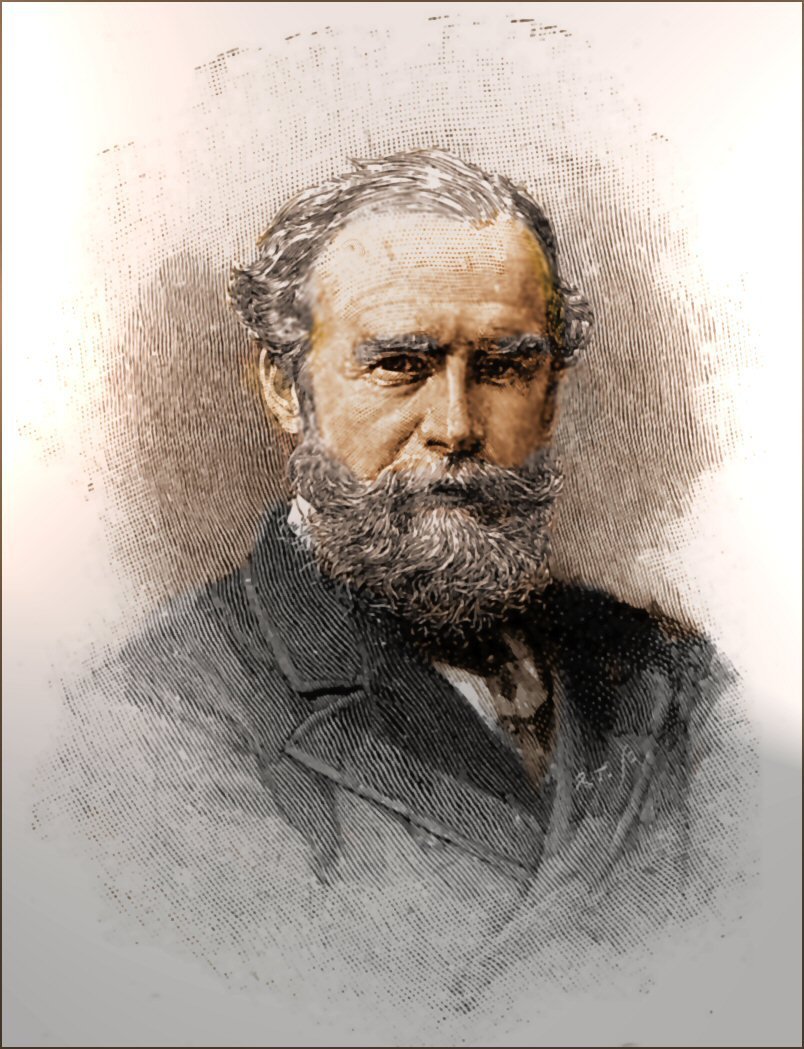
The Act established a number of official bank holidays in England, Wales, Ireland, and Scotland. These days were initially intended to close banks, but in practice they quickly became general public holidays, as other businesses followed suit. In England, Wales and Ireland, the original bank holidays were Easter Monday, Whit Monday, the first Monday in August, and Boxing Day. In Scotland, they fell on New Year’s Day, Good Friday, the First Monday in May, and Christmas Day.
The act of 1871 also made it lawful for any day to be officially proclaimed a bank holiday in the United Kingdom5. As a result, they became so popular that they became known as ‘St Lubbock’s Days’6 for a period of time.
The Spring Bank Holiday today
The Spring Bank Holiday as we know it today evolved from Whit Monday7, which was traditionally observed as the day after Whit Sunday, a Christian festival which was observed on the seventh Sunday after Easter and celebrated the descent of the Holy Spirit upon Christ’s disciples. The word Whit is thought to derive from the Anglo-Saxon word ‘wit’ meaning ‘understanding’8,
Whit Monday had long been a popular day for fairs, community gatherings, and leisure, particularly in industrial towns, where it offered a rare opportunity for rest and recreation. Because Easter is a movable feast, the date of Whit Monday varied from year to year, sometimes falling as early as May and sometimes as late as June.
By the mid-20th century, the varying date was increasingly seen as inconvenient, especially for modern industries, schools, and transport planning. In response, the government passed the Banking and Financial Dealings Act 19719, which reorganised bank holidays across the UK. As part of these reforms, Whit Monday was replaced by a fixed Spring Bank Holiday, set on the last Monday in May. This change came into effect in 1978 in England, Wales, and Northern Ireland (Scotland followed a different holiday pattern).
The decision to fix the date had both practical and symbolic implications. This change not only aligned the holiday with modern work patterns but also marked a shift from purely religious observance to a broader cultural and leisure-focused celebration, creating a predictable long weekend that could be planned for well in advance, benefiting businesses and families alike. While the religious significance of Whitsun remained within church calendars, its associated public holiday was transformed into a broader celebration of late spring.
Celebrations
Today, the Spring Bank Holiday in the UK is celebrated primarily as a long weekend for rest rather than as a religious observance. Falling on the last Monday in May, it is widely seen as a marker of late spring and the informal start of the summer season. Most offices, banks, schools, and government departments are closed on this day.
Over time, it has become associated with leisure, tourism, and cultural events and is often linked with outdoor activities, festivals, and sporting events such as football fixtures, cricket matches, horse racing, marathons, and fun runs. In some years, the holiday has been moved to take on a national or ceremonial dimension, such as royal jubilees10, adding street parties and public celebrations to the mix, the most notable being for Queen Elizabeth II’s Golden, Diamond, and Platinum Jubilees in 2002, 2012 and 2022.
There are also some more specific traditional events that have stood the test of time and still take place today. These include:
- Tossing the sheaf11- This takes place in Endon, Staffordshire. Participants in the event compete to see who can toss a bale of straw the highest.
- Well-dressing12 - This tradition is strongest in the Peak District counties of Derbyshire and Staffordshire and involves the decoration of springs and wells with pictures made from living plants and flowers. Its origins are somewhat of a mystery, but it is thought to date back to pre-Christian times, when pagan people would express gratitude for having a reliable source of drinking water during the drier, hotter months.
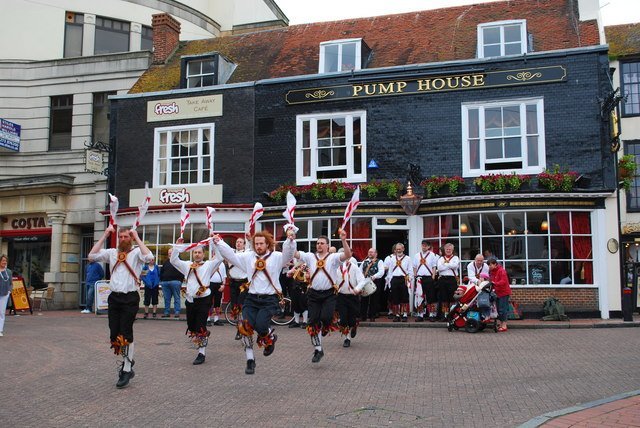
- Morris dancing13 - This is a traditional English folk dance performed in groups, often during spring and early summer festivals. It features coordinated footwork—including steps, hops, and leaps—accompanied by bells strapped to dancers’ shins, props such as sticks or handkerchiefs, and live folk music.
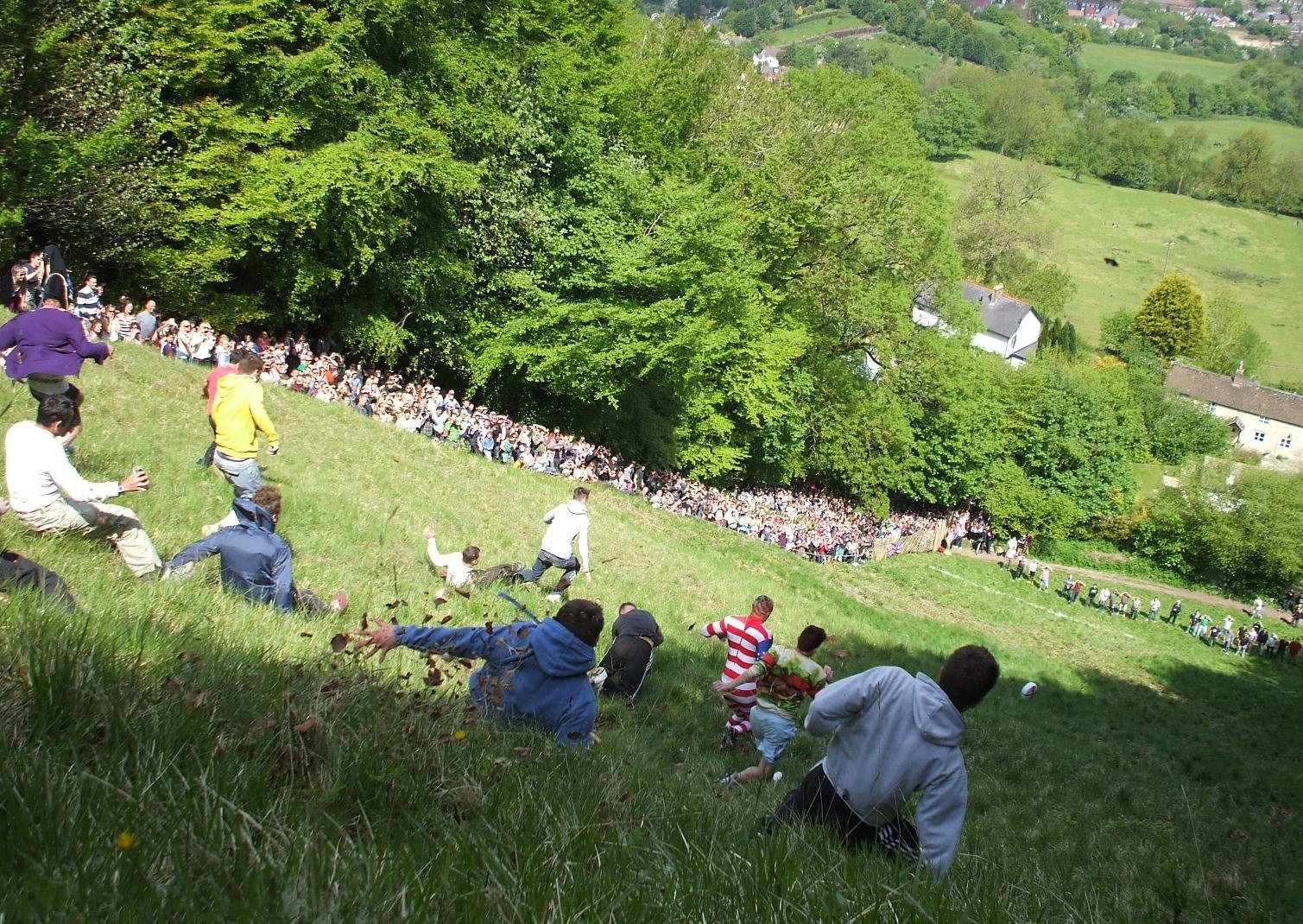
- Cooper’s Hill Cheese-Rolling and Wake14 - this annual cheese rolling event attracts thousands of people to Cooper’s Hill in Brockworth. This whacky event sees participants throwing themselves down a 180-metre steep hill after a wheel of Double Gloucester15 cheese weighing around 3.5kg. The first person to cross the finish line wins the wheel of cheese.
- Whit walks - Traditionally, Whit Walks (which celebrate the birthday of the Church) took place on Whit Monday, but when this was replaced by the Spring Bank Holiday (the last Monday in May) in 1978, many organisers moved their Whit Walks so that people would still be free to attend. One of the most famous is the Manchester Whit walk16. The first event was held in 1801 and is said to have arisen out of the Sunday School movement17. The walks see children, choirs, clergy, and dignitaries taking part in colourful processions through industrial streets, often accompanied by brass bands.
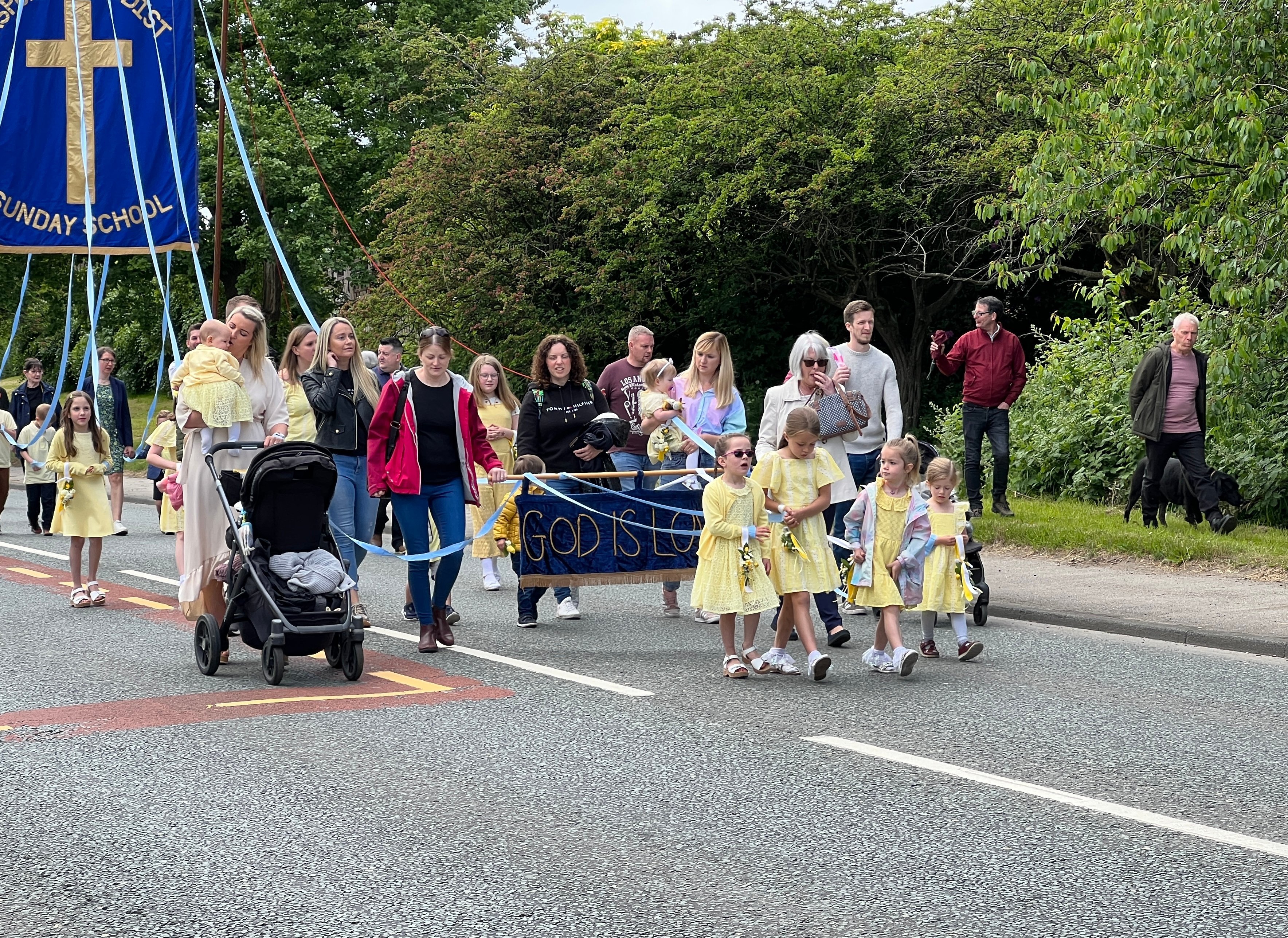
In summary, the Spring Bank Holiday today is best understood as a shared national break that combines relaxation, outdoor living, cultural events, and local identity. While its religious roots remain in the background, its modern meaning lies in providing time for rest, enjoyment, and community and marks the passing from spring to summer.
References
Bank holidays (GOV.UK) Official list of bank holidays for England, Wales, Scotland and Northern Ireland.
holiday (n.) – Online Etymology Dictionary Notes the word comes from Old English haligdæg (‘holy day’).
An Act for Observance of the Fifth of November 1605 (3 & 4 Jac. I c.17) The original British statute enacted to require annual remembrance of the Gunpowder Plot and 5 November.
Sir John Lubbock, 1st Baron Avebury (1834–1913) The politician, scientist and social reformer.
Encyclopædia Britannica: Bank holiday Bank holidays and how the term is used in the UK and other countries.
Nine things you might not know about bank holidays BBC overview of surprising facts and traditions linked to UK bank holidays.
Whit Monday in Britain The history and traditional observance of Whit Monday across the UK.
When is Whitsun. The dates and meaning of Whitsun/Whit Sunday celebrations in the UK.
The UK Bank Holidays Act 1971 The full text and contents of the law governing official bank holidays in the United Kingdom.
History of Royal Jubilees Historic Royal Palaces article on the origins and celebrations of British royal jubilees.
Spring Bank Holiday in the UK Overview of how the Spring Bank Holiday began and how it’s celebrated today.
Well Dressings in the Peak District A guide to the traditional floral well‑dressing celebrations and events in the Peak District.
Encyclopaedia Britannica: Morris dance On the history and traditions of Morris dancing in Britain.
Gloucestershire Cheese Rolling The traditional and quirky annual cheese‑rolling competition in Gloucestershire.
Double Gloucester cheese The traditional English cheese often associated with Gloucestershire cheese rolling.
Whit Sunday traditions in Manchester On Whit Sunday celebrations in Manchester and surrounding areas.
The Sunday School Movement On the history and impact of the Sunday School movement.
Read Also
-
Nine things you might not know about bank holidays BBC feature uncovering quirks and lesser-known facts.
-
Well Dressing Historic UK guide to the ancient English water-source decoration tradition.
-
The ancient practice of well dressing Countryfile article on origins and modern survival of the custom.
-
The Manchester Whit Walk Explains the religious procession tradition linked to late spring holidays.